
| It took a little convincing, but the folks at Dave & Buster's finally came around and made the jump to a cashless system for their successful chain of bar/entertainment centers. A decade later, the rest of the amusement industry is catching on, too.
Cory Haynes, vice president of amusement operations for Dallas, Texas-based Dave & Buster's, says back in the early 1990s his company was worried about what a switch from coins to debit cards would do to its profitable business. Would the change go over well with customers? Would it be beneficial for management? Would it change the Dave & Buster's image too drastically? “Our stance had always been that the coins hitting the pan were a draw—like Vegas,” Haynes says. But Jorge Mochkovsky, owner/director of Sacoa Entertainment, producer of the Play-Card cashless system since 1992, convinced Dave & Buster's executives otherwise during IAAPA's 1995 convention and trade show. |
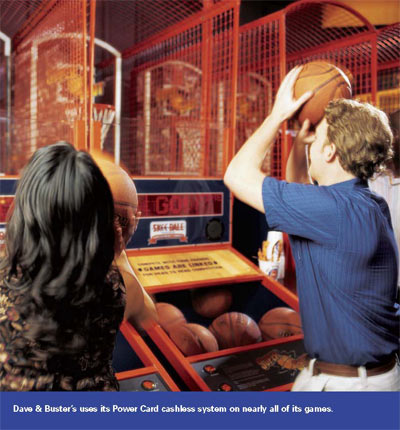
“I can remember it very clearly,” Haynes says. “We were sitting outside the hall in Orlando at one of the little luncheon counters” as Mochkovsky pitched his system. “We said, ‘There's no way—we'll kill our business if we go to swipe cards.' He said, ‘I promise you, you won't.'” Best. Decision. Ever. Ten years down the road, Dave & Buster's is one of more than 300 FECs and arcades around the globe using Sacoa's system, while countless other entertainment centers have also made the switch using similar forms of the same general technology. Dave & Buster's is effervescent in its praise for Sacoa's PlayCard (dubbed “Power Card” by the Texas franchise). “With the Sacoa Power Card, Dave & Buster's revenue has increased, our customer service has been enhanced, and it put us on a platform that can keep up with our rapid growth,” says co-founder Dave Corriveau in a testimonial on Sacoa's web site (www.playcard.com.ar).
|
“Reliability and support far exceeded our expectations. We're extremely happy.” Amusement parks have taken notice of stories such as this, but only now has technology advanced to the point where these larger facilities can finally take the plunge themselves—and soon. How It Works When Dave & Buster's opened its first location in 1982, all of its games operated on coins the chain calls “chips.” The entertainment centers still use chips, only now customers put them on their Power Cards instead of in their pockets. The cards meant an initial boost of revenue because of “the credit card theory,” Haynes says: “People don't realize how quickly they're spending them.” Beyond the credit card theory, though (which eventually levels off, Haynes says), the digital method provides three essential benefits for arcades and entertainment centers, says Paul
|
32 FUN WORLD April 2005
 |
Schulte, vice president of sales for Inter-card, Inc., a Maryland Heights, Missouri, manufacturer of cash control systems since 1979 and producer of the “Total Solution” cashless system. First, Schulte says, the cards are a boon for marketing because facilities can send out promotional cards with built-in bonuses, establish different pricing for different times of the day, or create membership programs that provide benefits for various levels of commitment. The Power Card's impact on marketing for Dave & Buster's is profound, Haynes says, because his company uses incentives to encourage customers to keep their cards. For example, customers' gaming histories are recorded, allowing them to make use of frequent-player bonuses. Also, Dave & Buster's recently added a feature where tickets earned at redemption games are stored electronically on the Power Cards. Now, Haynes says, customers keep their Power Cards in their wallets just like any other
|
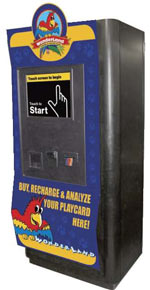
membership card; when they're out shopping and pull out some other card, they see the Power Card and it reminds them of Dave & Buster's. Haynes says surveys show customers are overwhelmingly in favor of the cashless system—built-in incentives aside, he says they appreciate how the cards eliminate the age-old problem of coins jamming in games. Dave & Buster's also has a continual contract with Sacoa for further developments, as the entertainment chain makes its Power Card even more integral to its overall operation. Recent upgrades include a $10 “Power Hour” card sold during Happy Hour, where customers have 60 minutes to play as many video games as they can squeeze in. Dave & Buster's also now has a party system where cards of varying denominations can be sold in large batches to a group and remain linked throughout a visit. That way, a manager can add a bonus $5 or other incentives to each card in the party with the touch of a
|
|
April 2005 FUNWORLD 33
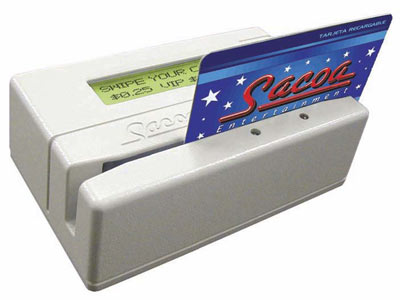
button, making the overall Dave & Buster's experience that much better for the customers. “We have developed a good synergy [with Dave & Buster's],” says Pol Mochkovsky, marketing director for Sacoa's PlayCard. “They are very aware now of the system's potential and demand ever more complex functionality, which we are proud to fulfill.” Schulte says cards also ease operations. Because nearly all business is conducted digitally, fewer employees are handling cash or tokens and thus the chance of theft is reduced. Dave & Buster's has nearly eliminated all coin collection, Haynes says, except for the coin action games, which require a physical token to play. (For these units, customers swipe their Power Cards to receive coins from a machine.) In the past, Haynes says his company had problems with employees palming quarters from its machines as they made their rounds. Now, he says, “you know you're getting the majority of your money. If you have less to manage, the better you can manage it.” “There's basically no chance of fraud or employee cheating or manipulation” |
|
 |
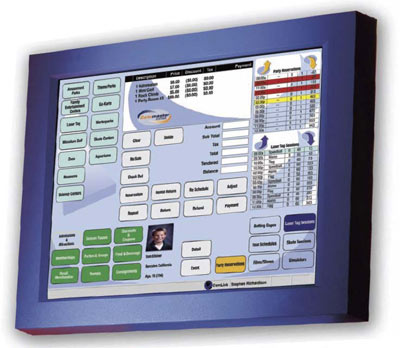
using a cashless system, Intercard's Schulte agrees. “There's just no way to put money on a card without it being traced back to who put it on. [Employees] have to be accountable for how much they put on, because at the end of their shifts it's going to come up right there on their reports.”And this leads to Schulte's final prong of the cashless approach: accounting. Since cashless systems are run by computers, their reporting is done in real time, so facility owners and operators know exactly where their bottom lines stand at any given moment and can keep track of cash flow throughout the day. Cashless is also infinitely adaptable; smaller FEC owners can monitor their businesses from the comfort of their homes, while larger companies with multiple locations can keep tabs on everything from one location. This capability for accurate, immediate reporting is one of the main draws for the larger theme parks, Schulte says. ‘It's Going to Saturate the Market' Industry experts agree: Amusement parks have wanted to experiment with cashless systems for some time, but, for most facilities, the technology simply wasn't available or cost-effective. Until now. For a cashless system to work at a park, every square inch of the facility must be linked to a computer network. For years, the only way to accomplish this goal was to lay cable below the ground, installing a physical network connecting computer to computer. For new parks, this task wasn't too difficult, says Brad Feinman, assistant consultant for California-based GateMaster Sys-tems—the network could be folded into the overall production plan and budget. But retrofitting existing parks with cable is an expensive, intrusive process, Feinman says, typically outweighing desires for cashless systems. The “exponential” growth of wireless technology in the past year has changed the entire equation, however, Feinman says. Parks that couldn't afford to install a cable network can now drop in some wireless hubs and be up and running without missing a beat—and without a tremendous hit to their budgets. “These parks that have wanted to implement a cashless system, now they can do it very easily,” Feinman says. |
|
April 2005 FUNWORLD 35
they put their money in a locker and go on the rides,” Feinman says. “When it’s time for food or they see something they want to buy, they don’t have access to their money, so they wait. With the implementation of cashless, [parks] are able to tap into those impulse purchases. It’s a way for them to increase their sales. “The first concept in point of sale is, if you can make it easier for people to spend their money, then [companies] are going to do it,” he continues. “[Guests] put that money on the card, so they’re going to use it. They’re going to make sure they use every dollar that’s on there.” Cashless systems will also be particularly effective for pay-as-you-go facilities
such as Morey’s Piers in Wildwood, New Jersey, which was GateMaster’s first amusement park client, installing the equipment in 2003. Morey’s is going cashless in stages, says Sandy Verzella, information technology director
at the park; Morey’s started with cashless ticket booths and retail outlets but is moving toward phasing tickets out altogether in favor of card readers at all attractions. The park recently added palm readers for season pass holders; when they come up to the booth, their palm scans pull up a picture from Morey’s files, thus guaranteering |
so they're going to use it.They're going to make sure they use every dollar that's on there.”—Brad Feinman, GateMaster Systems |
 |
people cannot try and cheat the park by using yearlong tickets they “borrow” from others. “Now we’re catching everybody,” Verzella says, and other larger parks are catching on. “We think most of the entertainment businesses will end up using a cashless system,” says Mochkovsky, whose Sacoa PlayCard system is already in six amusement
parks (none in the United States, however). “It gives full control of the business and allows creating promotions and sales with huge flexibility.” “They’ve been looking for this solution
for a long time, and now the vendors
are out there to supply it,” Feinman says. “From the level of interest
we’re getting and from what we’re hearing at the trade shows, it’s going to be pretty much everywhere in the next two to five years.” |
36 FUNWORLD April 2005